NextUp

NFL In-Game Software Design

Collaboration with SAS
Timeline
8 Weeks
Feb - April 2025
Role
UX/UI Design
Tools
Figma
Adobe Photoshop
Adobe After Effects
Illustrator
Overview
To explore the opportunities of GenAI to keep track of stats and observations on a field, and help coaches respond with actionable and relevant strategies.
Why was it done?
Professional football coaches rely on preprinted game plans and video playback to make quick decisions mid-game. Choosing the next play is critical, but existing systems are organized to a static system.
Redesign Outcomes




Selected for patent consideration by SAS
Following the project, members of our team were invited to apply for a patent through SAS, for the intellectual property opportunities around aspects of NextUp and the concepts reflected in our deliverables.
Industry alignment
After the project's completion, the NFL and Microsoft announced new AI-powered coaching and game analysis capabilities for their sideline technology. The announcement highlighted goals similar to those explored throughout this project. This announcement reinforced our findings that real-time, AI-assisted decision support represents a meaningful opportunity within professional sports technology.
Gallery
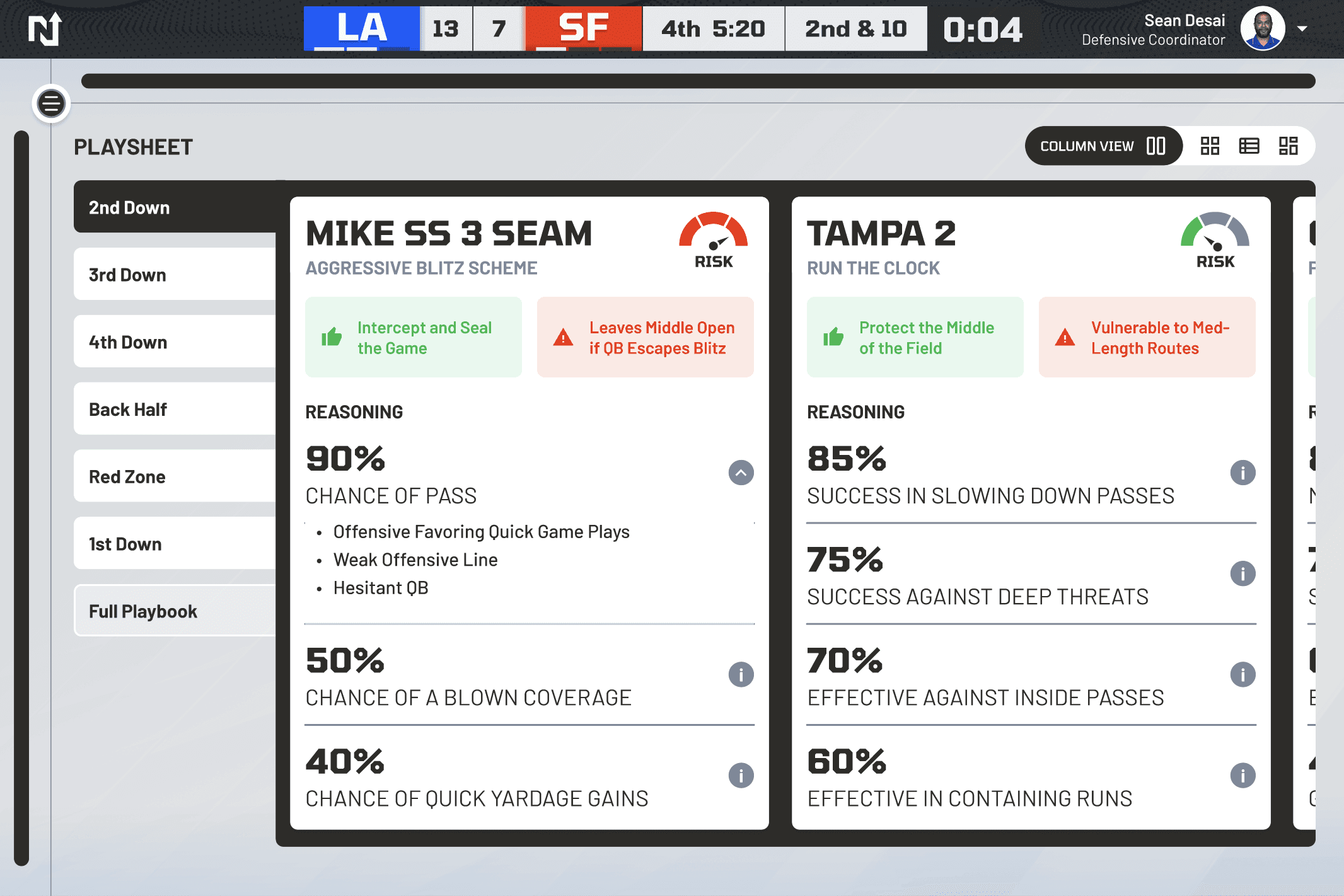
Introducing a new adaptive interface, NextUp highlights relevant opportunities in a tool that belongs on the professional field.

Outcomes

Discovery
Coaches are making critical decisions with tools that don't support decision-making in high-pressure environments.

Sean
Sean is an NFL Defensive Coach for the Los Angeles Rams. He decides his team's defensive strategy by analyzing the opposing team's recent performance.
Next plays are chosen from a prepared playsheet
A playsheet is a coach's primary reference tool during a game. Playsheets are prepared in advance and printed as a list, including all of the predetermined "plays" a coach may decide to run in a game.
Coaches get 25-45 seconds to call a play
Coaches analyze the opposing team’s performance and must determine their next play within a short decision window. They use this time to quickly scan their options from the printed playsheet for the best play at the given moment.
All NFL coaches have Microsoft Surface tablets
Since 2014, the League has provided an app for coaches to review and mark up video footage mid-game. Right now, coaches can use the tablet to review and mark-up game footage, but the software is limited in its capacity to help strategize.
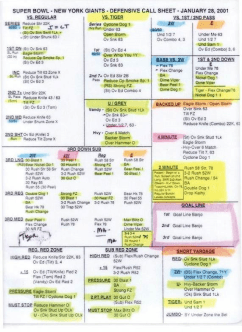

Playsheet Examples (Yikes!)
Strategy
Prioritizing our redesign goals and determining feasibility
Opportunities

AI sources and tech framework
Luckily, the NFL is rich in data sources. Players’ shoulder pads already have live RFID sensors tracking their position, direction and speed. Motion-tracked game footage recorded from the sidelines provides further insights from a variety of angles, beyond what’s shown to fans watching at home. And the game statistics that are already being tracked, such as passing yards, tackles, completions, and time of possession, factor into NextUp’s AI dataset in real time.

Process for User Scenario 1/2
Pre-Game: AI-Assisted Playsheet Development
In preparation for an upcoming game, Sean opens NextUp to build a new playsheet for his team to practice.
We started with crazy-8 sessions to consider the features, interactions and organizations we might want NextUp to have when not in-game, to best prepare for the next one. From here, we put together a streamlined user flow and low-fidelity wireframes.
This gave our team an opportunity to experiment with when and how AI features could present themselves, and allow questions to come up as we put our thoughts onto an interface.


AI integrates stats and observations from previous game footage into playsheets
Our vision was to work AI into playsheet development, to help coaches spend less time on game analysis and more time making strategic adjustments. We thought of AI as a coaching assistant, that could highlight which plays were working well, which weren't, and how they would perform against the upcoming opponent.

Key Insights for Mid-Fi
Coaches think based in situations
Current paper playsheets are organized by situation. We carried this feature more strongly into the mid-fi wireframes, allowing categories to be more representative of the sheet as a whole.
AI shouldn't be a sparkly button
Coaches wouldn't want to feel boxed into AI options, but requesting AI suggestions was the natural next step users would take. We realized we might as well integrate AI suggestions more seamlessly into the flow.
Design adapts for exploration
This scenario doesn't take place mid-game, it happens when coaches have time to review details and consider a broader range of play options. NextUp adapts automatically to support slower, focused decision-making.


SAS User Testing and Evaluation Notes

Process for User Scenario 2/2
In-Game: AI-Tailored Analytics and
Play Calling
Later in the game, Sean uses NextUp to help decide which play to call next.
We started with the same preliminary brainstorming sessions as done for Scenario 1, but shifted our focus to feature only the most relevant insights and recommendations to support quick, actionable decision-making.

AI-driven player insights organize performance data to help coaches see what trends and abnormalities are occurring
Focus is entirely on deciding the next action. AI provides analytics deeper than baseline performance data, and acts as a second set of eyes for the field. Information is automatically organized around the game state instead of static categories.

Context → Recommendations → Action
With early layouts, users struggled to determine where to focus first, especially so tight on time. Supporting information was moved into secondary layers and revealed only when needed.
Acknowledging physical constraints
Interactions must be intuitive and imprecise under stress, since input time is extremely limited. We made a more adaptive interface that could be swiped around to focus in and out as needed.


SAS User Testing and Evaluation Notes

Soution
NextUp evolves the printed playsheet with AI
By rebuilding a coach's playsheet as a responsive decision system, NextUp allows coaches to focus their expertise and take action under pressure.
NextUp Walkthrough (3 Minute Video)
Design 1/3
Organized In-Game Playsheet
Interactive playsheets display quick information on play's pros and cons

Design 2/3
Player Insights
NextUp synthesizes performance data to surface trends and abnormalities to help coaches identify areas for improvement.
Design 3/3
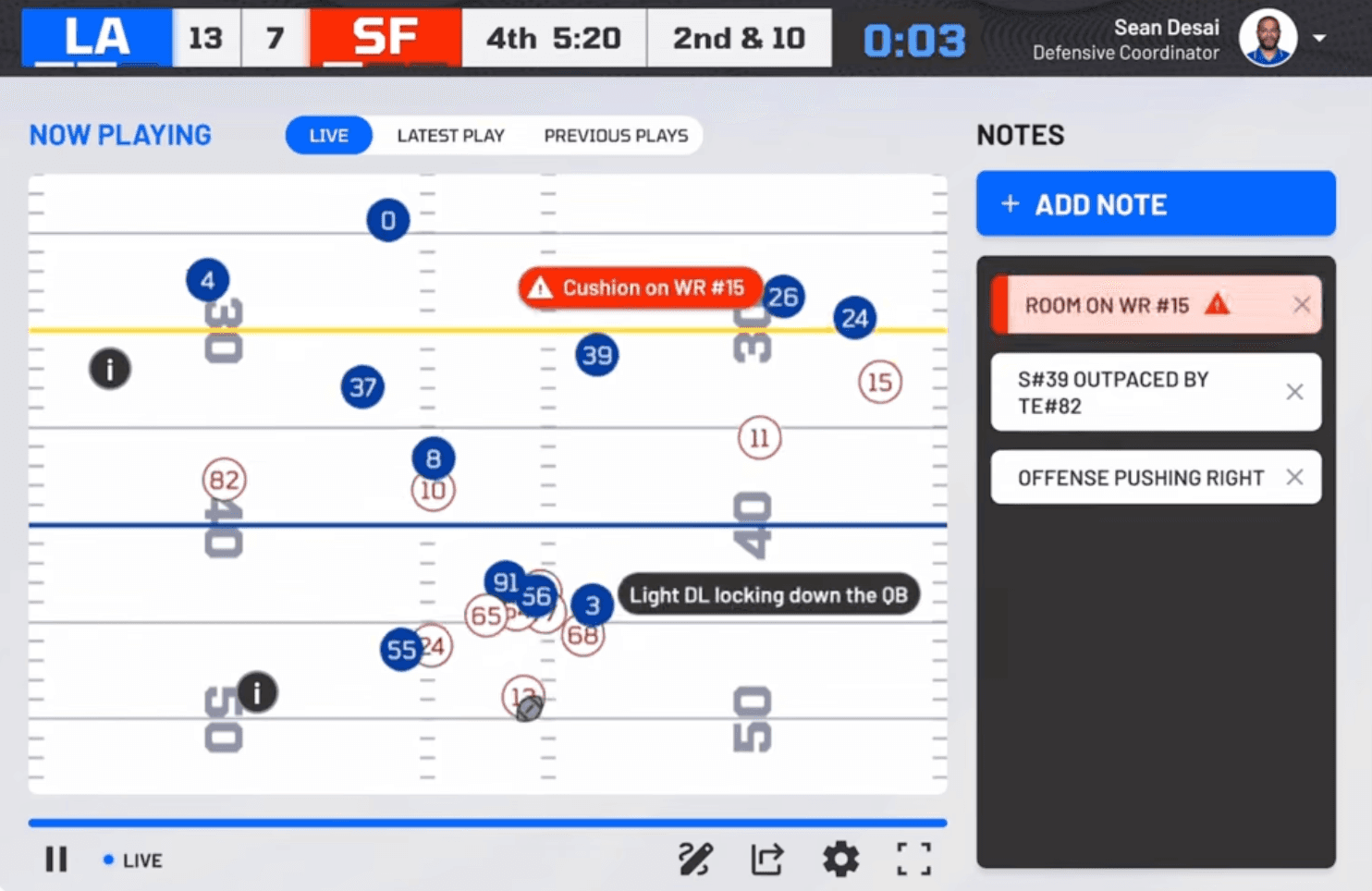
Automatic Notes
Smart video replays monitor the entire field and highlight all critical observations over playback, not just the center of action.
Reflections
Key Learnings
You don't have to solve everything
Our team felt overwhelmed by the amount of data there was and analytics we could surface in this interface. But we learned to prioritize the impactful data, so that users could stay focused. More data doesn't always make for more educated decisions.
Keep AI open and honest
AI should support expertise, not replace it. This project changed the way I think about AI, because it should not be an SOS button. The challenge was integrating it into the flow and leaning into its capabilities, without taking away a coach's judgement. We used AI to filter and organize information, and act as an attentive backup to help make and organize observations. AI brought relevant next steps to the front, surfaced qualitative analysis and comparison, but allowed coaches to make the final call.
What I'd Build Next
Detailed Post-Game Reviews
Generated from in-game notes, videos and insights.
Close the Loop With Customized Reports
Reports tailored for coaches to share with individual players, to analyze and improve their performance.